

What's the Best Age for Kids in Fleet, Farnham and Yateley to Start Piano Lessons?

Actually, let me reword that a little - at what age should kids in our local area start MUSIC lessons? Because music is so much bigger than learning to play the piano!

Second question: What's location got to do with it? Everything! Because what you choose depends on what's available in the first place.
Thankfully for you, if you're reading this, you probably live in the vicinity of the Three Counties border (Hampshire, Surrey and Berkshire), and I'm pleased to say, we have some excellent choices nearby! But I'll leave those for later.
First of all, I'm going to be honest - if you're the parent of a kid younger than six, I'm going to try and put you off piano lessons - but do not despair, the most important musical learning happens under the age of 7; I would go so far as to say under the age of 3!
Best age for piano lessons
Here's the quick answer to the first question: Most kids are ready to have 1:1 instrumental lessons from about the age of eight; six if they're generally pretty studious and showing a special interest, and a few (very few!) are ready even younger. But as a rule of thumb - the younger you start 1:1 lessons, and the more complicated the instrument (piano is NOT the most straightforward), the more patient support they will need and the more the motivation will have to come from you, the parent.

My oldest started drums at the age of 8; he's now 15, approaching Grade 7 and teaching his own students to earn extra pocket money. We didn't have much input - I'm just constantly amazed at his incredible cross-body-co-ordination!
My daughter was 4.5 when she started violin. That was much more time-intensive. She's now 9 and loving it more and more. We practise together pretty much every day. It's our joined passion, but it's asked a lot of both of us in terms of patience and persistence.
What to do in the meantime?
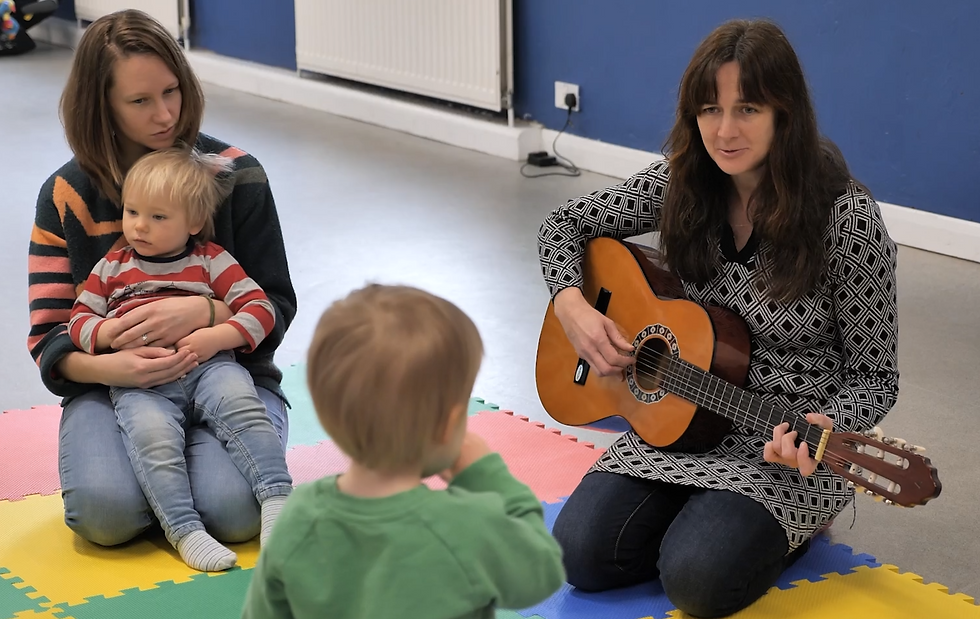
But what about younger kids then? Well, the answer to that is, go for musician-led group music lessons instead of 1:1 piano lessons.
Here's a quick breakdown to help you decide...
1:1 Piano Lessons | Group Music Classes |
Require sustained concentration | Are varied – include movement, props, and a mix of instruments |
Ask children to sit or stand still for long stretches | Are active and playful, with frequent changes of activity |
Focus on mastering technical skills of one instrument | Build broad music skills through singing, rhythm, movement, and games |
Need very well-developed fine motor skills | Develop both gross and fine motor skills |
Require daily practice to make progress | No home practice required – children naturally sing/play songs outside class if they enjoy them |
Progress depends on disciplined repetition | Progress comes through playful exploration and shared experience |
Can feel solitary | Are social – children learn with and from others |
Expensive compared to group classes | More affordable than 1:1 lessons |
Accessible only when a child is developmentally ready (usually age 6+) | Can begin from birth – developing beat, tuning, and listening skills that support later music learning (and even language development) |
I'm all for learning to play instruments - when the time is right! But if reading this is making you wonder whether your child hasn't reached the best age for 1:1 (piano) lessons (yet), let's look at how you can find ways to nurture their musicality in the meantime.
Find an independent, musician-led early years music class near you!

Ages 0-7 is when the music magic happens
Asking a child to learn an instrument if they've never sung or moved to music is a bit like asking them to read and write without ever having learned to speak! As with language, it's so important to immerse them in a rich musical environment from birth; one where they hear songs and rhymes they can copy, where they feel movement to the beat and enjoy all of this with their favourite people. If you're looking for ways to boost this, my top tip is: Find an independent, musician-led early years music class near you.
Why the insistence on independence and musician-led? Well, quality really matters. As with food, locally and independently produced trumps supermarket quality hands down pretty much every time. It's the same with music classes. Musicians and music teachers will have a far deeper insight into how to nurture children's musicality than other providers without their training.
Quality really matters.
They can help your child discover their voice (tunefully) through age-appropriate songs rather than shouting along to the latest Disney track (amazing though the music is!).
They can help you child develop real sensitivity for beat and rhythm through a wide variety of movement games and instruments, rather than simply jumping up and down to a backing track chosen for how it pleases the adults.
They can create the space to make your child feel safe enough to share their own musical ideas with the group (this takes such sensitivity on the part of the teacher, and can easily be crowded out by entertainment-heavy lesson planning).

How to find a class
My top tip: break it down into two steps.
Find music classes in your local area through word of mouth, Google, social media - however you find things these days.
Do your research on each of them. The following questions could help you:
Are the classes led by musicians? Or simply training offered by a branded organisation?
How heavily does the class rely on backing tracks? Remember: the more backing tracks, the less space for your child to truly express themselves
Is there a progression to the classes? Some classes stop when school starts. The benefit to joining a program that continues throughout school is that the teachers know what they're working towards, and are able to unlock much more musical development, than class leaders who only work with Early Years groups.
Will your child learn real music skills in the class? Or is it only about social, physical and language skills? You go to swimming classes to learn to swim; the same needs to be true for music classes. Many music providers emphasise the language, literacy and social skills, and these are important. But - so is music! Language, literacy and social skills are already wrapped up in all the musical activities, so do make sure you go for a class that develops good listening, movement and vocal skills from the start, because this is what our kids deserve.
Make sure the class works for you. Go for a trial. Do you like the class? Do you think your child is comfortable? They may observe rather than join in the first time round. That's completely normal. But if your gut feeling says yes, then a quiet trial in a high-quality class is better than enthusiastic participation in kiddie disco. Do day, time and place work for you? Go with your gut - it's got to work for you!
Finally, if all of that resonates with you, why not take a quick peek at our classes to see if there's something you'd like to try? At Vivace Music School, we run classes for children from birth to senior school - yes, that's right. All the way! We offer one-off free trial classes in our entry-level classes for ages 0-7 years (5-8 years for home educated children), which you can book here: https://www.vivacemusicschool.co.uk/
We also offer block-trials (6 weeks paid) for children over the age of 8 and 1:1 sessions (minimum 3 sessions paid block trial) for children with SEN. For the latter, please contact us.


Comments